The LinkedIn Makeover That Gets You Hired
Stop using your profile like a storage box. Turn it into a landing page that does the selling for you.
Most LinkedIn profiles read like a list of things just dumped together on one page. Old job titles stacked on top of each other. A headline that just repeats your current role. An About section nobody finishes. It just sits there, doing nothing.
A profile that gets you hired works like a landing page instead. You land on a good one, and within a few seconds you know what it does, who it's for, why it's worth your time, and what to do next. Your LinkedIn needs to do that exact job for the one recruiter scanning it with ten seconds and zero patience.
What a makeover actually looks like
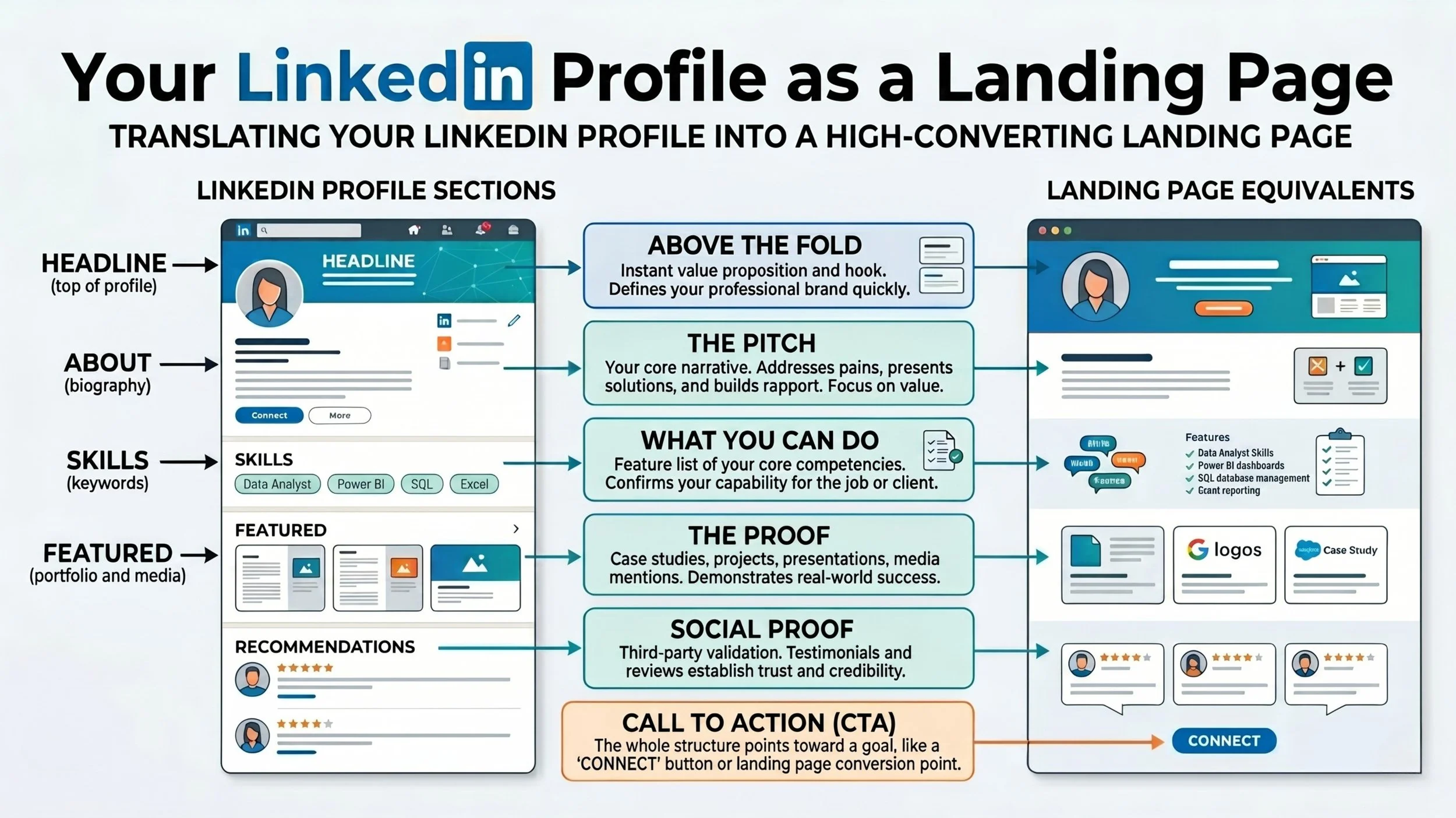
Before the makeover, the headline just repeats a job title, the About section lists duties nobody reads, the skills are a random six, and the whole thing is written in company jargon an outsider can't follow. Recruiters scroll straight past.
After, the same person has a headline that says who they help and how, an About that sounds like an actual human, a skills list pulled straight from the jobs they want, and a few wins in plain English with proof sitting right there. Now recruiters reach out first.
Same career. Same person. The only thing that changed was how clearly the page sold them.
The key moves (and why they work)
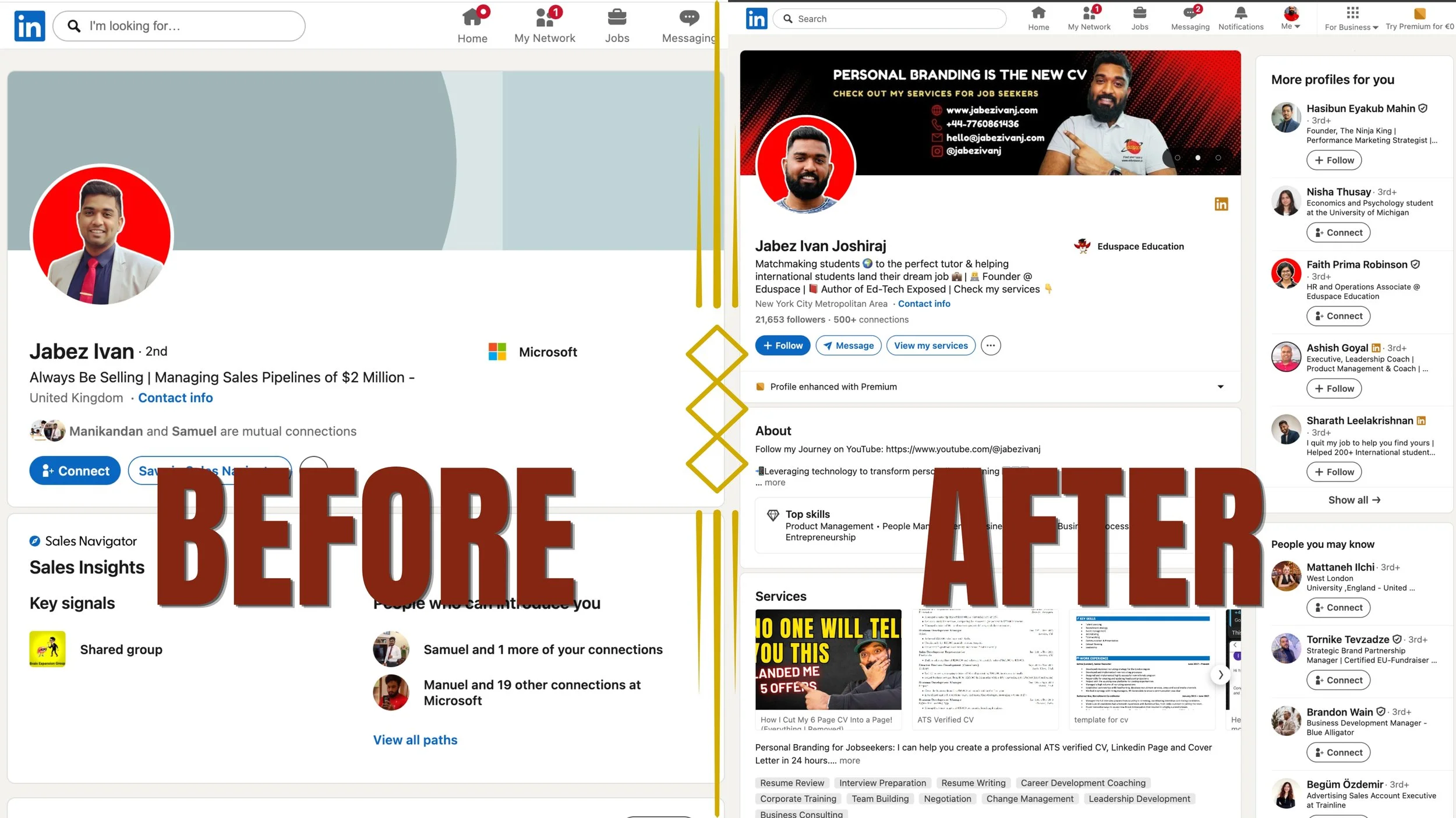
1. Your headline is the part above the fold
Why it works. It's the first line a recruiter reads, and often the only one. They also search LinkedIn by keyword, not by job title, so a headline that only says "Customer Success Manager" leaves you invisible to half the searches that could have found you.
Do this. Use a simple format: who you help and how, plus what makes you different, plus one proof point. Something like, "Helping SaaS teams cut churn and grow revenue | Customer Success Leader | 8 yrs." Work in three to five keywords from the roles you actually want.
When did you last change your headline? If it still matches a job you've already left, that's move one.
2. Your About section is the pitch
Why it works. This is your handshake. Picture someone who spent nearly two decades inside a giant tech company. Real, serious experience, all of it buried under internal language nobody outside the building could understand. Until they rewrote it in plain words, recruiters genuinely couldn't tell what they'd done. When I was recruiting, I'd give a profile about ten seconds. If I couldn't work out what someone did and who they did it for, I was already onto the next one.
Do this. Answer six questions in plain English: who you are professionally, what problems you solve, what roles or industries you're aiming for, your strongest skills, your proof, and the kind of conversations you want. Write it the way you'd explain your job to a friend, not to a boardroom.
Read your first line the way a stranger would. Would they actually get what you do?
3. Your skills show what you can do, and LinkedIn now leans skills-first
Why it works. Recruiters increasingly search by skill, not title. A half-empty skills section makes you invisible to that whole way of finding people. The people who fill theirs out properly, with every skill pulled from the jobs they want, start showing up in searches they used to miss completely.
Do this. Open five to eight job descriptions for your target roles and note the skills that keep repeating. Add those, starting with the five to ten that matter most, and drop dated baseline stuff like "Microsoft Word."
Quick win. Paste a job description into Claude and ask it to pull out the skills worth listing. It's the boring part, so let Uncle Claude do it. Ten minutes, done.
If a recruiter searched your top skill today, would you even come up?
4. Proof is your portfolio, so show the work
Why it works. Anyone can type "strong communicator." Proof is what a hiring manager actually believes. Picture an editor who'd been job-hunting for years. When a referral finally sent a hiring manager to her profile, the videos she'd produced and a link to her work were already there, doing the talking for her.
Do this. Use your Featured section. If your work is visual or creative, put up samples. If you're in sales, ops, or finance, add a short case study, a before-and-after of a process you fixed, a one-page project summary, a deck, or a result with a number on it. Proof works for every kind of role, not only designers.
What on your profile right now proves you can do the thing, instead of just claiming it?
5. Point the page in one direction and cut the clutter
Why it works. A landing page that sells five things sells nothing. Imagine someone aiming for program management who still had old art and teaching experience sitting up top. It confused LinkedIn so badly the platform kept feeding them the wrong jobs. Clear it up, aim everything one way, and both the algorithm and the human finally understand you. If your profile reads like program manager, artist, teacher, marketer, consultant, and chef all at once, the algorithm gives up, and so does the recruiter.
Do this. Decide the one direction you're pointing in, then cut or reframe anything that pulls away from it. You don't always have to delete the past. Reframe it. "Art teacher" becomes "Ran creative sessions, planned structured lessons, managed engagement, and reported progress to stakeholders." Now it reads like operations and program management.
If a stranger read your whole profile, could they say in one line what you do?
6. Drive the traffic: be visible, and ask the right way
Why it works. The best page on earth does nothing if nobody sees it. Two things bring the eyes.
Posting keeps you in mind. Someone who posts most weekdays, nothing fancy, a thought from an interview or a repost with an honest take, stays fresh in their network's memory. So when a role opens up, a former colleague already thinks of them and refers them before the job is even public. You don't have to become a full-time creator. Be visible and useful, that's the whole game.
Referrals open the door, but only if you make them easy. A vague "can you refer me to anything at your company?" hands the other person all the work, so they quietly do nothing. Name the role instead: "I saw the Program Manager role and it lines up with my experience in operations and stakeholder management. Would you be comfortable referring me for that specific one?" Now it's easy to say yes.
When did you last ask for a referral by naming the actual job?
7. Watch the numbers (optional)
Why it works. If you have LinkedIn Premium, you can see who's been viewing your profile, which tells you when someone from a company you applied to is checking you out. Handy if you've got it, not a must.
Do this. Keep a light eye on profile views, search appearances, and who's landing on you. When the numbers climb after a change you made, you know it's working.
The makeover checklist
Do these in order. Not one of them costs a thing.
Rewrite your headline so it says what you do and who you help, with three to five keywords from your target roles.
Rewrite your About in plain English, answering the six questions above.
Pull skills from five to eight target job descriptions and add the ones that repeat, starting with the top five to ten.
Cut or reframe any experience that pulls away from your one direction.
Add proof to your Featured section: samples, a case study, a deck, a result.
Ask two or three people for a recommendation, ideally someone senior.
Post something useful at least twice a week so your network remembers you.
Send one referral request that names the actual role, not "anything."
Personalise your profile URL, and sort out your photo and banner.
Check back in two weeks: are your profile views and search appearances climbing?
Your profile is the answer to one quiet question every recruiter asks as they scan: what can this person do for me, and can I tell in about ten seconds? Right now, yours is either answering it or wasting it.
You don't have to do all ten today. Pick one. Start with the headline if you're unsure, because it's the fastest win and the first thing anyone sees.
And if this was useful, follow along and share it with someone stuck in the silence. I post the stuff recruiters won't say out loud, so your job search actually starts working.
Peace. ✌️