Revolut Interview Breakdown and Step by Step Guide
This is Based on My Revolut Journey: From Rejection to Offer
It was a cold evening in December. I’d already half-checked out for the day.
Then the email landed. Revolut. Polite enough to sting.
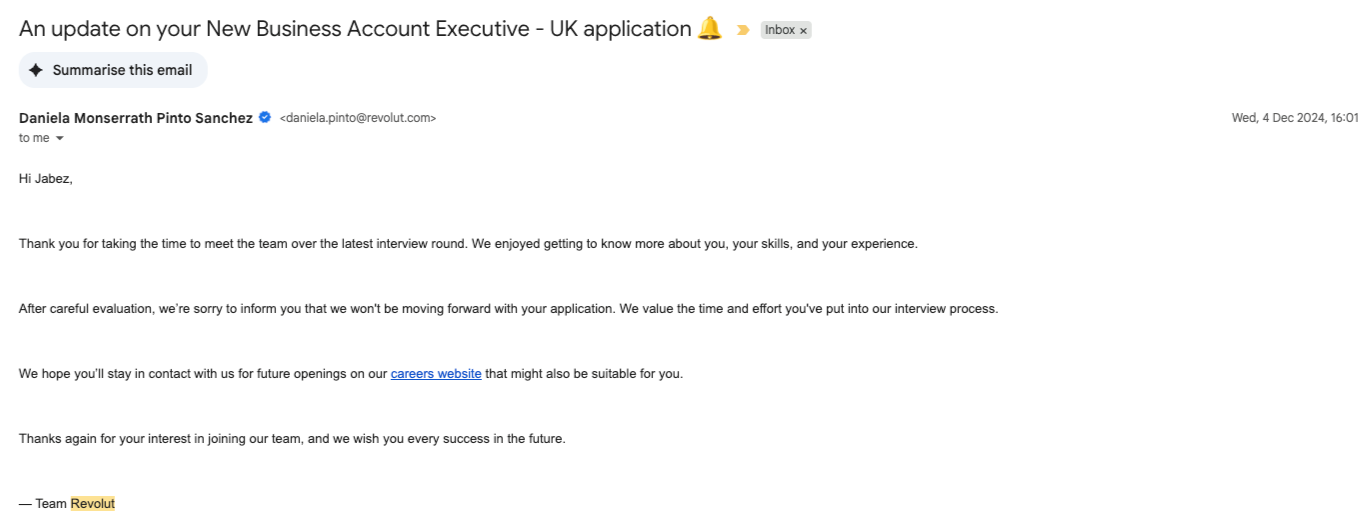
“Thank you for your interest… we won’t be moving forward with your application.”
You know that drop in your stomach. The role you’d quietly pictured yourself in, gone in two sentences. 🫠
I read it twice. Moved my cursor toward delete.
Then I did the thing almost nobody does.
I hit reply.
The reply that kept the door open
Not an angry one. Not a “your loss” one. A real one.
I thanked the recruiter, for the time the team had spent with me. I told him, honestly, that I was disappointed, and that I was still impressed by the bar they hold for their work. Then I asked one small thing: “What’s the one thing that would have made me an easy yes for this role? A single sentence is perfect, I’ll use it to get better.”
And I asked to stay in the pipeline. To be considered when something new opened up.
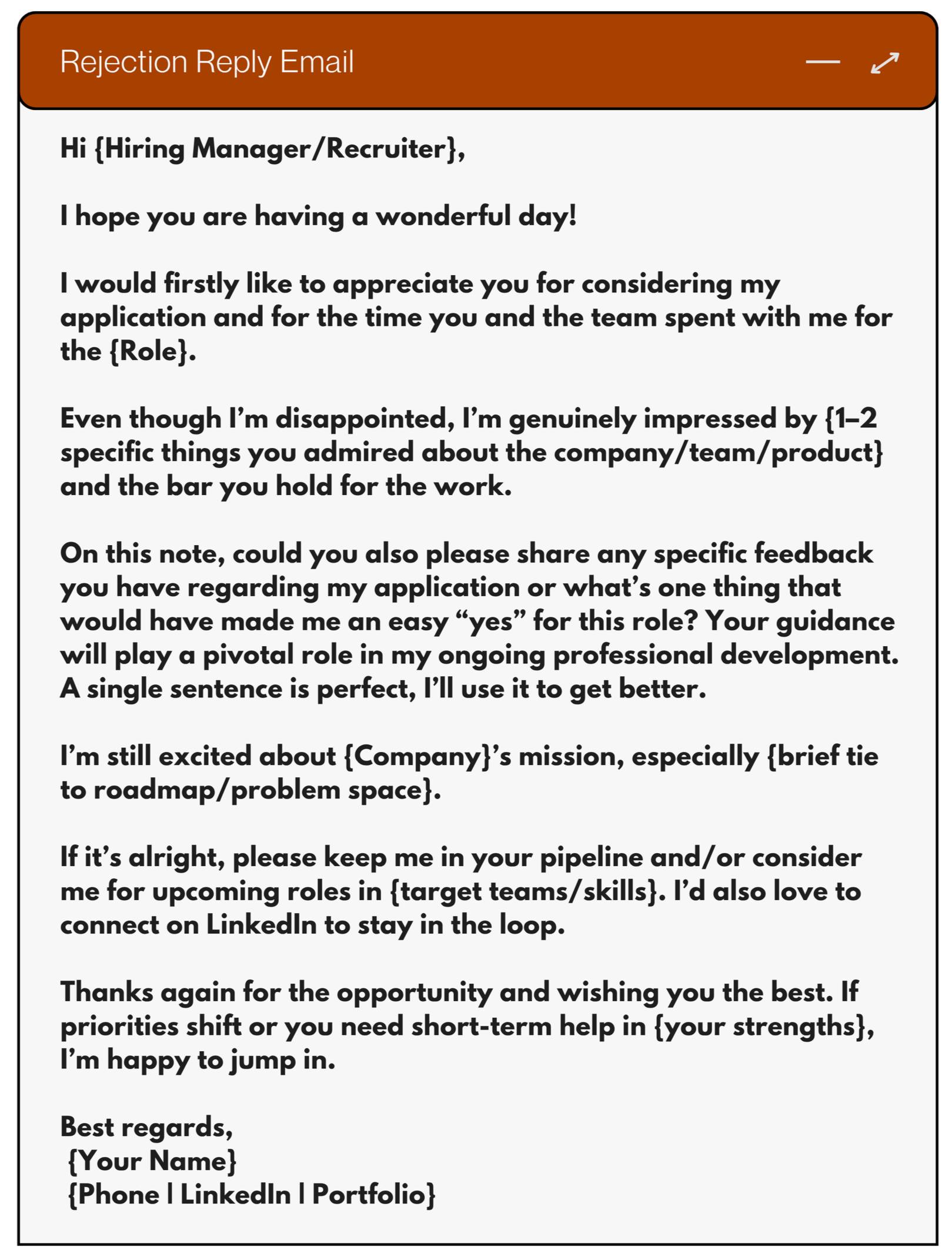
Rejection Email Template
Then I closed my laptop.
Quick gut-check before you read on. When did you last reply to a rejection instead of deleting it? Be honest. The delete button feels like closure. Actually, it’s you shutting a door that was only ever on the latch.
Then, nothing
Here’s the deal with what came next: silence.
Days went by. Then weeks. You know that quiet after you send something that mattered, the one where you refresh your inbox like it owes you money. 😅
I didn’t chase. I kept showing up where they could see me, engaging with Revolut’s posts on LinkedIn, staying genuinely curious about what they were building. Then I got on with my life and the rest of my search.
Months passed.
The email I wasn’t expecting
Then one morning, eight months later, a new email. the recruiter again.
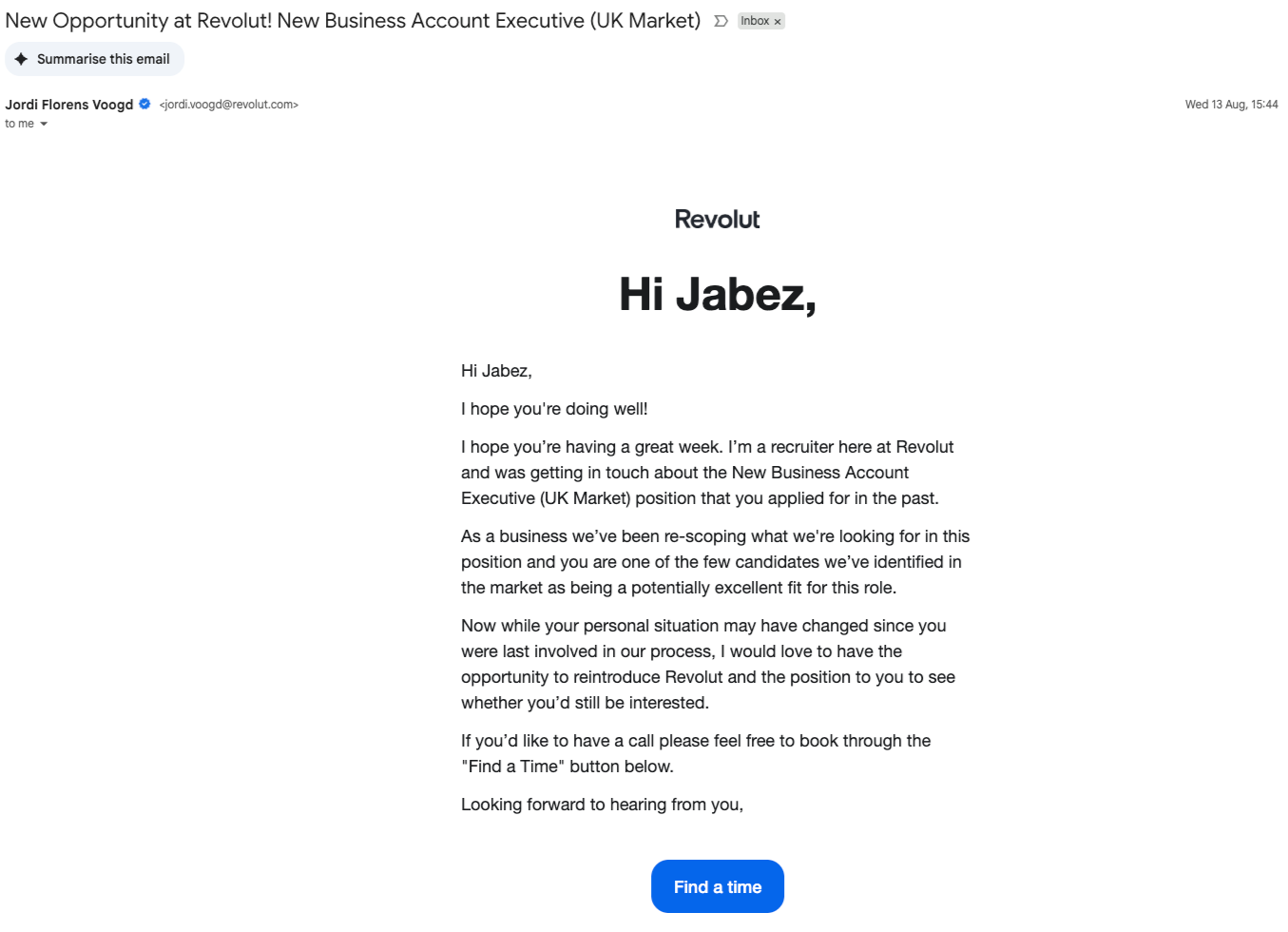
“We’ve re-scoped the role. You’re one of the few candidates we’ve identified as an excellent fit.”
Read that line again. The same company that passed on me circled back. And the only reason there was a conversation in August is the reply I sent in December.
I asked for the answer key (and got it)
A lot of people in my shoes would just say yes and wait to be told what happens next.
I asked a question instead: “Could you share what each stage will test, and how I should prepare? And who’ll be interviewing me?”
The recruiter sent back a full breakdown. Every stage. What it tested. What to focus on. He basically handed me the answer key.
Sit with that for a second. The roadmap was available the whole time. I just had to ask for it. Recruiters genuinely want you to do well, because a strong hire makes their job easier and gets them back to the next thing on their list. So ask who’s in the room, what kind of round it is, and what they’re looking for. Then go quietly study every interviewer’s profile before you ever meet them. 🕵️
The “informal” call that wasn’t
The first round was an “informal catch-up call.” That’s what they called it.
I treated it like an audition, because every call is one, even the ones they label casual.
So I read up on the recruiter/hiring manager properly: his background, what he cares about, and his recent posts. And I didn’t show up with a flat “I’m good, thanks.” I had something real ready: “Honestly, a bit nervous but really excited. I’ve been looking forward to this, because what Revolut’s building for small businesses lines up with what I care about.”
Honesty check. If a recruiter called it “just a casual chat” tomorrow, would you show up casual, or prepped like it counts? It counts.
Research beat the more qualified candidate
The screening rounds went deep on my sales background, my numbers, and one question that comes up every single time: “Why Revolut? Why now?”
I had an unfair advantage there, and it wasn’t talent. I run a business (Eduspace), and we use Revolut Business to actually run it. So I wasn’t reciting features off their website. I knew the product as a customer who relies on it. That kind of depth shows up in about two minutes, and recruiters can feel the difference between someone who studied and someone who genuinely gets it.
Then came the cultural round, and Revolut sent me their actual company values to prepare against: resourcefulness, persuasiveness, resilience, empathy, and a handful more.
So for every value, I wrote a STAR story that proved I lived it. (STAR is just a simple way to structure an answer so it lands: the Situation you were in, the Task you owned, the Action you took, and the Result, with a number on it wherever you can.) One value, one or two real stories. Like: “When I led a cross-functional project, I cut delivery time by 25% by spotting the bottleneck early and building trust with the people who could fix it.”
Be honest with yourself right now. Could you name your target company’s values without looking them up? And do you have a real story for each one, with a result attached? If not, there’s your weakness. ✍️
The round that actually scared me
The skills round was a live test. Fifteen minutes to find five solid leads using only Google and LinkedIn. Screen shared. Thinking out loud. And one rule, in bold: no AI tools.
Which is funny, because I’d spent weeks letting Uncle Claude do my grunt work to get there.
The boring, soul-draining prep nobody wants to do, I handed most of it over. I had Claude help me build my Master Interview Document, the one place that held my opening pitch, my STAR stories, my questions for them, and my closing line. I used it to map my stories to each Revolut value so I wasn’t scrambling. I had it pull together company research and draft the kind of follow-up email I’d need to fire off fast.
Then, on test day, I closed all of it and did the thing live. On my own.
That’s the honest version of using AI in a job hunt. Claude builds the muscle in the gym, the quiet reps you put in for weeks. You’re the one who shows up on game day and lifts. The prep made me fast and calm when it counted, and no screen-share rule could take that away from me.
The role-play and the final boss
The same round threw a role-play at me. Pitch Revolut Business to a mock client. Handle their objections. Then write and send a real follow-up email within fifteen minutes of finishing, as if the client were sitting there waiting on it.
I’d practised all of it out loud. Recorded myself pitching to a camera, watched it back (painful, useful), and written objection responses for the “it’s too expensive” and “we already use someone else” curveballs. I’d pre-drafted email templates so I could personalise one fast under the clock.
Then the final round. A Country Manager. The closest thing this process had to a final boss. 🎮
Same themes, higher stakes: my journey, my numbers, my proudest wins, and “how will you thrive in a fast-paced, outbound team?” I came in treating it like a two-way conversation, not an interrogation. I asked what success looked like in the first six months. I asked what separated a good performer from an exceptional one. And I closed with something I actually meant: “This conversation has only made me more excited. I’m confident I can bring value early, and I’d love to keep going.”
The ten-minute habit most people skip
Within 24 hours of every interview, I sent a personal thank-you email. Never a copy-paste. Each one referenced something specific we’d actually talked about, and reminded them I was genuinely interested.
It takes ten minutes, and it keeps you on their mind while other candidates go quiet. Quietly, it also tells them you’ll treat their clients the same way you treated this whole process.
The email I’d been chasing since December
Then it came, just not the way I’d pictured it back in winter.
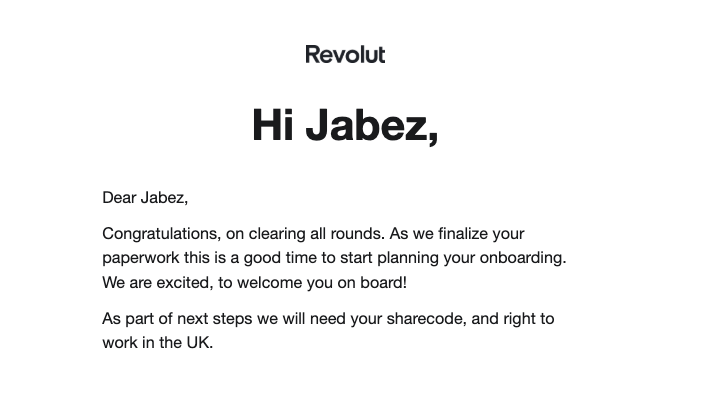
“Congratulations on clearing all rounds. We’re excited to welcome you on board.”
The same role that opened with a rejection closed with an offer. Eight months apart. One warm reply in between.
What I want you to take from this
A rejection email can be a door left on the latch, for the people who knock again with grace instead of bitterness.
Preparation usually beats raw talent. The person who shows up ready tends to outwork the more “qualified” candidate who’s winging it, every time.
And the work that wins, the research, the stories, the follow-ups, the master doc, most of it is boring. That’s the good news. Boring is repeatable. Boring is something you can start tonight.
So let me leave you with the real one. There’s probably a rejection sitting in your inbox right now, maybe one you deleted last month. What if that wasn’t the end of the story, just the first line of it?
Go reply. 💬
Want the exact toolkit behind this?
Watch this full tutorial if you need help getting into Revolut: https://youtu.be/X_wowL4B3Gk
And if this was useful, follow along (Instagram: @jabezivanj). I share what actually worked for me and the 3,000+ job seekers I’ve walked through this, in plain English, no fluff.
You’ve got more leverage than that rejection email made you feel.
Peace. ✌️