Stop Rewriting Your Resume Every Time You Apply 📄
Build one master file for one role. Then spend ten minutes per application instead of ninety.
I’ve worked with over 3000+ jobseekers and taking care of hiring in roles I have been or for my business. And there’s a moment in the screening process that still bothers me.
You've got a stack of applications open. Twenty tabs, maybe more. You're not reading. You're scanning. Eyes drop to the first bullet under the most recent job, looking for one thing: can this person do the work we need done?
And then you hit a resume where you can't tell.
Not a bad resume. The person clearly worked. The job titles are fine, the company names are real, the dates line up. But every bullet reads like it was copied off the job description they were hired under. "Responsible for managing stakeholder relationships and supporting delivery." Okay. Doing what? For whom? With what result?
So you're sitting there doing detective work. Piecing together what this person actually owned. And somewhere around bullet four you notice you've spent longer on this one file than the last six combined, and you still don't know.
That's when the resume loses. Not because the person wasn't qualified. Because they made the recruiter guess, and the recruiter had eleven more files to get through before lunch.

The loop you're probably stuck in
Here's what I see when someone sends me their setup.
They open an old file. Swap a few words to match the posting. Paste in some keywords they think the system wants. Rewrite half a bullet. Run it through a free ATS scanner, get a score of 62%, panic a little, add more keywords. Apply. Close the tab.
Three weeks later they've got six files on their desktop. Resume_final.docx. Resume_final_v2.docx. Resume_marketing_ACTUAL.docx. None of them says clearly why they're a fit for anything.
Be honest for a second. How many versions of your resume are sitting in your downloads folder right now? And could you tell me, without opening them, what's different about each one?
Yeah.
That loop feels like effort. It burns two hours per application and produces almost nothing, because you're editing at the surface while the underlying problem sits untouched: you never built a proper bank of evidence in the first place. You're rewriting sentences when you should be collecting proof.
The fix is one document, and it's not the one you send
Think about your wardrobe for a second.
You don't buy a new outfit every time you get invited somewhere. You own clothes. When something comes up, you open the wardrobe and pick.
Your resume should work the same way.
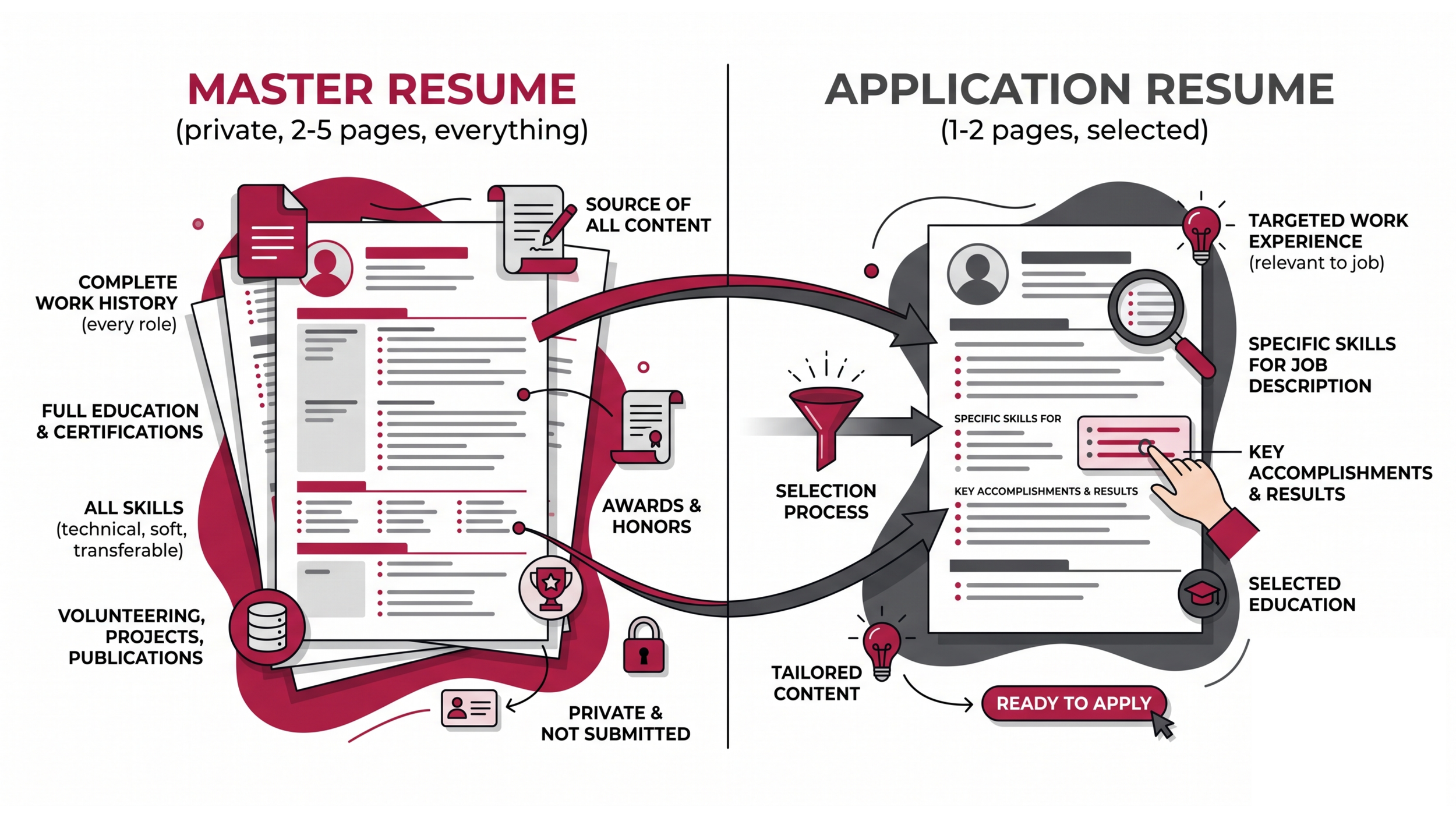
You build one master resume for one target role. Not "marketing." Not "operations, project management, and also sales if they'll have me." One specific job family, like Customer Success Manager, or Lifecycle Marketing Manager, or Data Analyst.
That master file is your private wardrobe. It can be two pages. It can be five. Nobody ever sees it. What lives inside it:
Every relevant accomplishment you can think of. Two or three different versions of your strongest bullets from each role, because you'll want options later. The tools, skills and projects that matter for this role. The exact language employers keep using when they describe this job. And the best proof you own that you can actually do the work.
Then the file you submit is the outfit. One or two pages, pulled from the wardrobe, chosen for the specific room you're walking into.
So when a good posting shows up, you're not rewriting your resume. You built the application version once, out of the wardrobe, for this target role. After that, each application is a small, fast edit at the top of the page. That's a different activity, and it takes a fraction of the time.
Part 1: pick a template that gets out of the way
Your format has one job. Make your experience easy to find, easy to read, and easy for a machine to parse.
That's it. That's the whole job.
It doesn't need skill bars, a headshot, a two-column layout, a colour block, or a little photo of the company logos you've worked for. Those things rarely make you memorable. What they reliably do is make you harder to scan and harder for an applicant tracking system to read correctly.
Single column. Clear headings. Standard fonts. Done.
Two free options I point people to, both on Overleaf.
The Harvard-style resume template, if you want something traditional, simple and versatile. It works for almost any background and nobody has ever been rejected for using it.
The FAANGPath Simple Template, if you're a technical candidate, a student, or early in your career. It gives you a clean structure for projects and skills, and it parses cleanly, which matters more than it sounds like it should.
Both are boring on purpose. That's the point.
Use this order. Every time.
Name and contact. Professional summary. Key skills. Work experience. Education. Certifications. Projects.
Here's what goes in each one.
The top of the page
Firstname Lastname
Toronto, Canada | +1 416 555 0134 | firstname@email.com
yourportfolio.com | linkedin.com/in/yourname
Name first. Under it, the location of the job you're applying for, then your phone number, then your email. Next line down, your portfolio and your LinkedIn.
Two things people get wrong here.
The location line is the city you're applying into, not the city on your last utility bill. If you're an international student in Toronto going for Toronto roles, that line says Toronto. If you're planning a move, be ready to say so on the call without flinching.
And hyperlink your portfolio and LinkedIn. Live, clickable links. A recruiter who has to copy a URL out of a PDF and paste it into a browser is a recruiter who doesn't.
Professional summary
Three to four lines. Always.
You'll find people online telling you to drop it. Keep it. It's the only part of the page where you get to tell the reader what to think before they start scanning.
Write it in this order: your biggest career achievement, then past, then present, then future.
Grew net revenue retention from 94% to 112% across a 40-account SaaS
portfolio in 18 months. Started in support, moved into account management,
now leading customer success for mid-market clients at a B2B software
company. Looking to bring the same retention playbook to an enterprise CS
team.
Achievement, where you came from, where you are, where you're going. Four lines and the reader already knows how to read the rest of the page.
What it should never look like:
Results-driven professional with a passion for excellence
Go read your current summary. If it describes your personality instead of your work, it's giving the reader nothing to hold on to.
Key skills
Two lines. That's the whole section, unless you're a programmer, in which case you get a bit more room.
Line one: your top five technical skills for the role you're applying for, comma separated.
Line two: the tools, and specifically the ones named in the job description, comma separated.
Key Skills
Customer onboarding, renewals and retention, account expansion, QBR
facilitation, churn analysis
Tools: Salesforce, Gainsight, HubSpot, Zendesk, Looker
Both lines get rewritten for every single application. They're the fastest, highest-leverage edit on the page, and they take about ninety seconds once your Role Blueprint exists (more on that in Part 3).
One rule holds: only list a tool you could open right now and use.
Work experience
Company name, location, job title, dates. Three to five bullets per role.
And your bullets stay the same for every application.
That surprises people, so sit with it a second. Your bullets are your proof. Proof doesn't change because the posting changed. If you catch yourself rewriting bullets for every job, it means they were never strong enough to begin with, and the fix is in your master file, not in the application.
The summary and the skills lines flex. The evidence holds still.
Part 2 is all about getting those bullets right.
Education
Course details, university or school name with the location in brackets, then the dates.
BSc Computer Science, University of Toronto (Toronto, Canada) | 2019 - 2023
Certifications
The certification and who issued it. The issuer is half the value. "Google Data Analytics Professional Certificate, Google" tells a recruiter something. "Data Analytics Certificate" tells them nothing.
Projects
Four to five of them, and each one in challenge, action, result form.
Churn early-warning dashboard
Support flagged accounts too late to save them. Built a Looker dashboard
pulling product usage and ticket volume into a weekly risk score. Three
at-risk accounts identified and retained in the first quarter.
Students and career switchers, this section is where you win. It's where you get to show work when your job titles don't tell the story yet. And if you've got fifteen years behind you, projects still earn their place, because they show what you chose to build when nobody assigned it.
Four formatting rules, then we move on
Justify the text so the right edge lines up straight. Ragged right edges make a page look thrown together, and this one takes two clicks.
Send it as a PDF. Always. Word files reformat themselves on someone else's machine and you never get to see what they saw.
Single column, standard fonts, clear headings.
And on length, see below.
About the one-page rule
You've heard it stated like law. It isn't.
If you're a student, a recent grad, or you have under roughly ten years of relevant experience, one page is right.
Over ten years, go to two pages. But fill them. Two full pages, all the way down to the bottom of page two. Not one and a half. Not one and three quarters. A page that stops three inches early tells the reader you ran out of things to say about yourself, which is never actually true.
The rule underneath the rule: don't make a recruiter hunt for the evidence. If a line doesn't strengthen your case for this specific role, it's a candidate for deletion. Not from your master file. From the version you send.
Part 2: bullets that prove instead of describe
Look. This is where the whole thing is won or lost.
A weak resume lists what you were responsible for. A strong one shows what happened because you were there.
Weak:
Responsible for managing social media accounts and creating content.
Strong:
Planned and produced weekly short-form content across Instagram and LinkedIn, growing average monthly reach from 18K to 74K in six months.
Same job. Same person. The second one gives the reader something they can actually evaluate.
The formula
Every bullet does the same job: an action verb, the task or project, then the result, quantified, with the transferable skill sitting there in plain sight.
The full anatomy is Action + Scope + Method + Outcome.
In plain English: what did you do, how big was it, how did you do it, what changed after.
Here it is in one line:
Redesigned new-client onboarding for a 40-account portfolio by introducing a structured kickoff workflow and milestone tracking, cutting time-to-launch by 25%.
Action: redesigned. Scope: onboarding for 40 accounts. Method: kickoff workflow and milestone tracking. Outcome: 25% faster launch.
You don't need all four in every bullet. But if none of your bullets have them, a hiring manager has no way to understand what you personally contributed.
Kill the warm-up words
These phrases eat space and add zero credibility: helped with, worked on, assisted with, responsible for, successfully, results-driven, strategic, various, numerous.
Use verbs that say what you did instead. Built, analyzed, improved, launched, led, reduced, automated, negotiated, designed, implemented, coordinated, resolved, streamlined, grew, delivered.
And don't force "Led" if you didn't lead. "Built" or "coordinated" or "supported" is stronger when it's true, because you can defend it in the room.
Numbers help. Inventing them ends you.
Numbers give your work scale. They're useful, not mandatory decoration.
Things that count as a real metric: revenue influenced or retained, cost reduced, time saved, growth rate, conversion rate, customer count, project budget, number of stakeholders, team size, volume of work handled, delivery timelines, quality or error-rate improvements, and engagement, reach or adoption.
Scan that list against your last job. There are usually two or three sitting in there that you never thought to write down.
But if you don't have clean numbers, use concrete context instead. That works almost as well.
Instead of:
Improved internal reporting processes.
Write:
Consolidated weekly performance reporting from five separate spreadsheets into one dashboard used by the sales and leadership teams.
No percentage anywhere in that line. Still specific. Still tells the reader the mess you walked into, what you built, and who depended on it.
Where good bullets actually come from
People write weak bullets because they start with a blank page and ask themselves "what did I do in that job?" That question produces a job description. Every time.
Ask these instead:
What problem existed before I got involved? What was I asked to fix, build, launch, or deliver? What did I personally own? Who depended on my work? What changed after I did it? What was slow, messy, expensive, or unclear before? What tools did I use? What scale was involved, in customers or revenue or volume or headcount or deadlines?
Answer messy. Full sentences not required.
Here's a real-sounding messy answer:
After signup, customers kept asking the same questions and support was drowning. I worked with product and support to build a help centre and an email sequence. Tickets went down.
Now tighten it:
Partnered with product and support to build a self-serve onboarding email sequence and help centre, reducing repetitive post-signup support tickets.
Evidence first. Language second. Doing it in that order is the whole trick.
The four questions that kill a bullet
Before a bullet stays, run it through this:
Could someone else with the same job title copy this line word for word onto their own resume? If yes, it's too generic.
Does it show a result, a real scope, or a specific method? If not, add one.
Does it support the role I'm targeting? If not, keep it in the master file, leave it out of the version you send.
Could I explain and defend this out loud in an interview? If not, rewrite it or cut it.
That last one isn't negotiable. AI can find you better words. It cannot hand you experience you don't have.
Go open your resume. Read your top three bullets out loud. How many survive question one?
Part 3: let Uncle Claude do the boring part
Now the keywords.
The wrong way is what everyone does. Grab one job posting, pull out every noun that looks important, dump it into a skills section, hope the robot is impressed.
Here's what works instead.
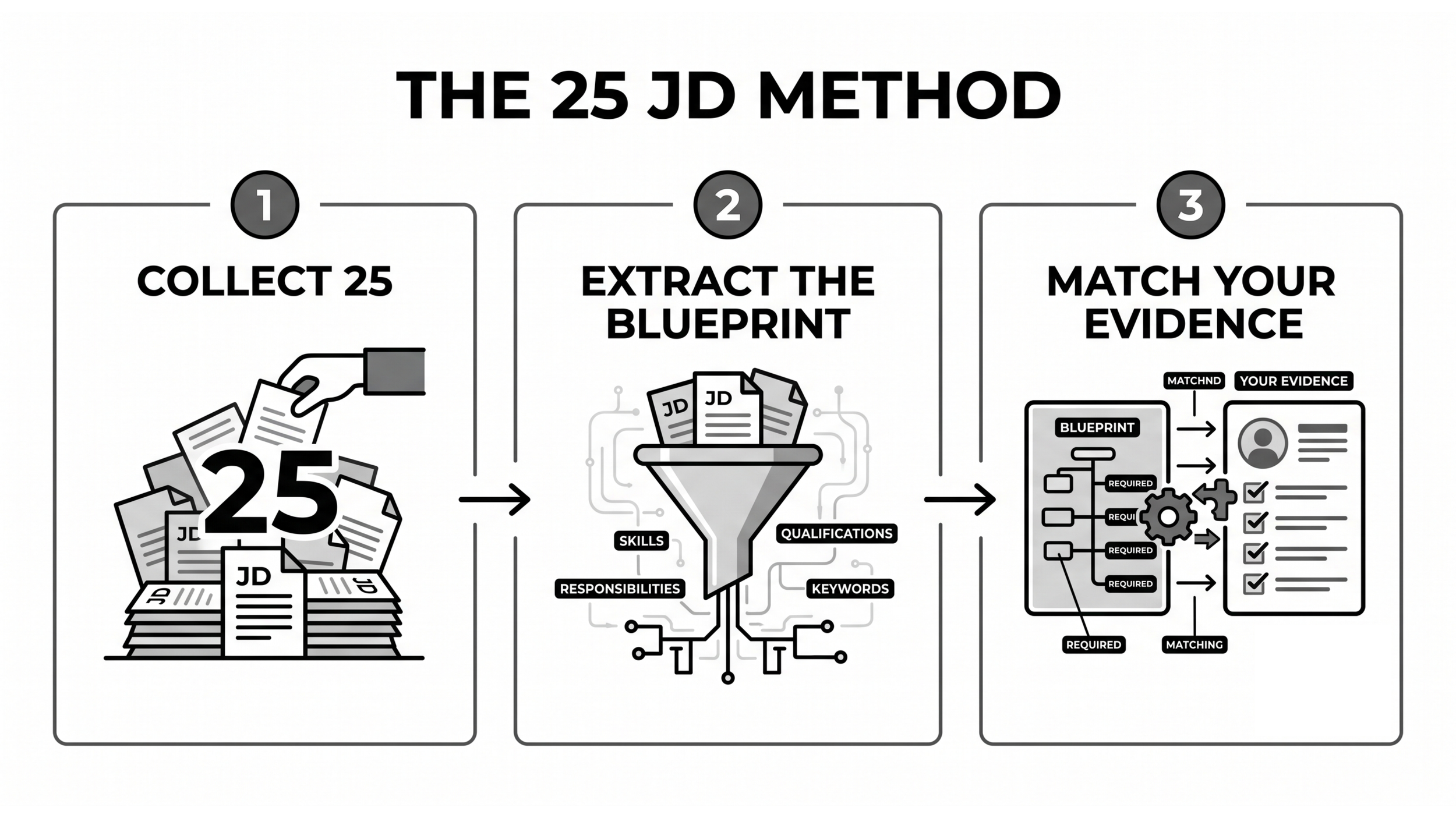
One job description tells you what one company wants this month. Twenty-five job descriptions for the same role tell you what the role is. One company cares most about onboarding. Another cares about renewals. A third wants enterprise experience. Across twenty-five, the pattern stops being opinion and starts being data.
This is boring, repetitive reading work. Which makes it perfect for Claude.
The 25 job description method
Pick one target role. Be specific about it. Not "marketing" but Product Marketing Manager, or Content Strategist, or Growth Marketer.
Go collect 25 recent postings for that role. Aim for genuinely similar seniority, function and industry. Copy them all into one document. It takes about forty minutes of clicking, and it's the highest-return forty minutes in your whole job search.
Then you have Claude pull out the repeated responsibilities, the required hard skills, the preferred hard skills, the tools and platforms, the industry language, the recurring business outcomes, and the seniority signals. Keywords that describe the work, not the personality traits.
Then run this.
Prompt 1: Build the Role Blueprint
You are an expert recruiter and resume strategist.

I am building one master resume for this target role:

[TARGET ROLE]

Below are 25 job descriptions for that role.

Analyse them and create a practical "Role Blueprint" I can use to build a
truthful, ATS-readable master resume.

Do not give generic career advice. Do not invent requirements that are not
present in the job descriptions.

Return the analysis in this format:

1. ROLE DEFINITION
- In 2-3 sentences, what is this role consistently hired to accomplish?

2. MUST-HAVE REQUIREMENTS
- List the 10-15 most recurring responsibilities, capabilities and
  qualifications.
- For each one include:
  a) the exact or near-exact language used in the job descriptions
  b) how often it appears
  c) whether it is core, common, or occasional

3. HARD SKILLS, TOOLS AND PLATFORMS
- Group into: Essential / Frequently preferred / Nice to have
- Include common variations and synonyms.

4. BUSINESS OUTCOMES EMPLOYERS CARE ABOUT
- What outcomes is this role expected to drive?
- Only include outcomes actually supported by the job descriptions.

5. KEYWORDS TO USE NATURALLY
- Give me a prioritised list of 30 keywords and phrases, separated into:
  functional / technical and tools / industry and domain / seniority and
  collaboration.
- Exclude empty buzzwords like "hardworking", "results-driven", "team player".

6. RESUME IMPLICATIONS
- What does a strong resume for this role need to prove?
- Give me the 6-8 types of evidence that should appear in experience bullets.

7. GAP CHECKLIST
- A checklist to compare my own experience against this role.
- Label each item: Must show on resume / Valuable if true / Do not claim
  unless directly experienced.

Here are the job descriptions:

[PASTE 25 JOB DESCRIPTIONS]
You'll get back a map of the role. Not a guess. A map.
Then take that map and hold your own experience up against it.
Prompt 2: Position your master resume against the Blueprint
I am targeting this role:

[TARGET ROLE]

Below are:
1. My Role Blueprint from 25 job descriptions
2. My master resume

Help me improve positioning without fabricating, exaggerating, or adding
skills I have not used.

First, build a table with four columns:
- Target requirement or keyword
- Evidence already present in my master resume
- Missing, weak or unclear evidence
- Suggested truthful improvement

Then:
1. Rank my existing bullets by relevance to this target role.
2. Recommend the best 3-5 bullets to use under each position for an
   application-ready version.
3. Suggest precise rewrites only where the underlying experience supports it.
4. Flag any requirement I should NOT claim based on the evidence provided.
5. Write a concise 2-line professional summary using only truthful
   information from my master resume.
6. Give me a final "human check" list of any phrases that sound generic,
   over-polished, repetitive or AI-written.

Rules:
- Never invent metrics, tools, ownership, leadership scope, customers,
  outcomes or experience.
- Preserve my actual seniority and career history.
- Prefer concrete language over corporate jargon.
- Every final bullet must be something I can confidently explain in an
  interview.

ROLE BLUEPRINT:
[PASTE ROLE BLUEPRINT]

MASTER RESUME:
[PASTE MASTER RESUME]
The word that matters here is overlap
Once you have the Blueprint, hold it up against what you've actually done.
You're not trying to turn yourself into the fictional ideal candidate the postings describe. Nobody is that person. You're finding the honest overlap between what this role keeps asking for and what you have genuinely done, then giving that overlap the most space on the page.
The gaps are useful too. They tell you what to go build, what to stop applying for, and what to stop apologising for in interviews.
Where the keywords actually go
The useful ones show up naturally in six places: your professional summary, your two skills lines, your job titles where they're accurate, your experience bullets, your project descriptions, and your certifications.
So if "stakeholder management" keeps appearing across your 25 postings, don't just drop it into a list. Show it:
Ran weekly delivery reviews with product, design, engineering and operations stakeholders to unblock launches across three priority workstreams.
The keyword is in there. So is the proof.
And a hard line, because I've watched this go badly: don't claim a tool you've never opened just because it showed up in 18 postings. Don't call one exported spreadsheet "data analysis." A recruiter might not test it. A hiring manager will. And the moment you're asked to walk through how you used it, the gap is visible to everyone in the room, including you.
Part 4: ten minutes per application
Once the wardrobe exists, this is the whole routine.
Minutes 1 to 2. Read the posting for priorities.
Don't open your resume yet. Read the job description and work out what business problem they're actually trying to solve. Which three to five responsibilities do they repeat? What must-have tools or domain knowledge appear? What seniority does the language imply?
Not every line in a posting carries the same weight. If "cross-functional launches" shows up once but "retention," "renewals" and "account growth" appear four times each, the company just told you what it's buying.
Minutes 3 to 5. Rewrite the professional summary.
Four lines. Biggest achievement, past, present, future. Same structure as always, but the achievement you lead with should be the one closest to what this company just told you it needs proof of.
If they repeated retention four times, your first line is about retention. If they repeated launches, your first line is about launches. Same career, different door.
Minutes 6 to 7. Rewrite the two skills lines.
Top five technical skills for this role on line one. On line two, the tools, taken from the posting itself, and only the ones you've genuinely used.
Then check your wording against theirs. If you managed client onboarding and this company calls it "implementation," you can write "Led client onboarding and implementation." But only if implementation honestly describes what you did. That's translation, not stuffing.
Your bullets, meanwhile, stay exactly where they are. You already chose the right three to five per role when you built this resume from your master file, and you already asked the three questions that matter at that point: which bullet proves I can do the most important part of this role, which one carries the most relevant tool or process or outcome, and which one is impressive but irrelevant here. That third question is the one people skip. Your proudest achievement stays in the master file. It doesn't automatically earn a spot on the page.
Ask those questions once, per target role. Not per application.
Minutes 8 to 9. Surgical AI review.
Don't ask AI to rewrite your resume. Ask it to check the match.
Prompt 3: The pre-submit check
Review this application-ready resume against the job description below.

I do not want a full rewrite.

Give me:
1. The 5 strongest alignment points already present
2. The 3 most important gaps or unclear areas
3. Up to 5 surgical edits that improve clarity or relevance
4. Any wording that sounds generic, exaggerated, repetitive or AI-written
5. Any keyword from the job description I can truthfully incorporate based
   on evidence already on my resume

Rules:
- Do not invent experience.
- Do not recommend adding skills, metrics or outcomes that are not supported
  by my resume.
- Do not optimise for an imaginary ATS score.
- Prioritise readability and credibility for a human recruiter.

JOB DESCRIPTION:
[PASTE JOB DESCRIPTION]

RESUME:
[PASTE APPLICATION RESUME]
Minute 10. The credibility check, then export.
Read every line on the page and ask one question: if an interviewer says "tell me more about this," can I answer clearly with a specific example?
Anything that gets a no comes off the page. Right then.
Then three seconds of housekeeping before you submit. Text justified. Page filled to the bottom. Exported as a PDF, with the links still clickable in the exported file. Open the PDF and click your LinkedIn link yourself. You'd be amazed how often it's dead.

What you're really building
Something worth sitting with.
Every line on your resume is a promise that you'll be able to talk about it. The keyword-stuffed version might get you into the room. It's the credible version that gets you through it.
So the goal was never to look qualified. It's to make your fit obvious, fast, to a tired person with eleven more files to read.
The best master resume isn't the longest or the prettiest or the highest-scoring on some scanner. It's the one that gives you a reliable bank of proof for the role you actually want, so you stop applying as a vague professional with transferable skills and start applying as someone who knows the function, speaks the language, and can point at specific work.
Use AI to spot patterns. Use it to dig up wins you forgot about. Use it to tighten a clumsy sentence.
Just don't outsource your credibility. That part has to be yours.
Pick your one target role this week. Open a blank document. Title it master resume. Start with the messy answers, not the polished bullets.
Everything else gets easier from there.
Peace. ✌️
If this was useful, follow along and share it with someone who’s searching for a job.
P.S. The three prompts above work best in order. Blueprint first, then positioning, then the pre-submit check.