How to network on LinkedIn (and actually get replies)
I applied to 656 jobs in my own job search experiment. I got 15 final-round interviews and 5 full-time offers. The applications that moved weren't the ones where I was the best fit. They were the ones where I'd already spoken to someone at the company.
If you want to watch the full guide on YouTube here is the link: https://yt.openinapp.co/u72hi
Why most LinkedIn networking gets ignored
Everyone tells you to network on LinkedIn. Almost nobody shows you how. So most people do one of two things.
They send 50 connection requests to anyone with "Recruiter" in their title. Or they message strangers with "Hi, are you hiring?" and wonder why nobody answers.
I hated networking for exactly this reason. It felt repetitive, a bit desperate, and it didn't work. Then I ran my own job search as an experiment and tracked what actually moved. The pattern was clear. The applications that went somewhere had a person behind them.
Networking isn't sending random requests to random people. It's choosing a few of the right people at a company you want, and giving them a clear reason to talk to you.
The more intentional you are, the better the result. That's what this whole newsletter is about: who to network with, how to reach them, and the exact words to send.
The three people worth messaging
There are three kinds of people at any company who can move your application. Each one needs a different approach, so it helps to know what each can do for you.
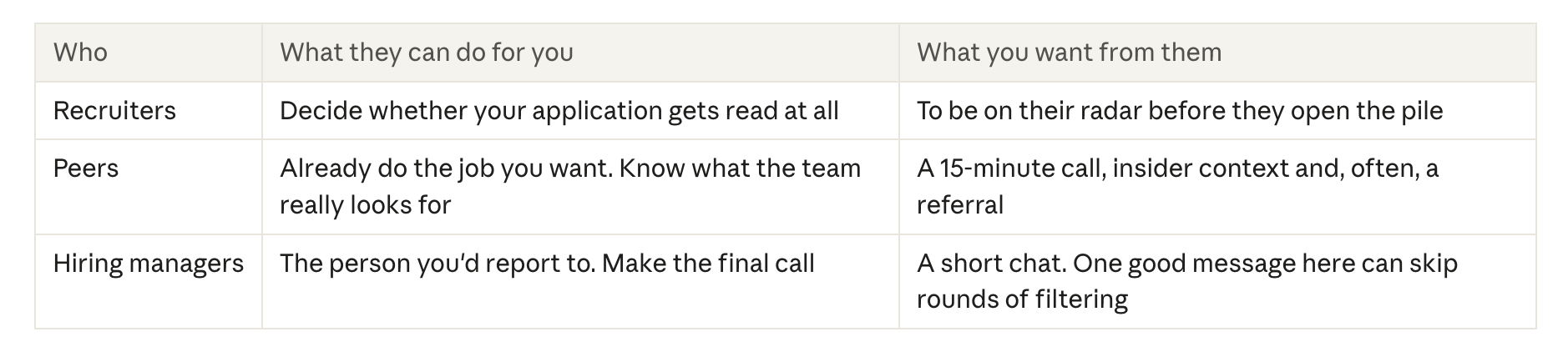
You don't need all three for every role. But the more of them know your name, the less your application depends on luck.
Fix your profile before you send anything
The first thing anyone does after getting your request is click your profile. If it doesn't tell them who you are in five seconds, your note won't save you. Check these four things first.
Your headline says what you do and what you're aiming for. "Open to work" tells them nothing. "Supply chain analyst | Moving into procurement | SAP, Power BI" tells them exactly where you fit.
You have a clear, friendly profile photo. Good light, your face, a normal background. It doesn't need to be a studio shot.
Your portfolio or website link is easy to find. Put it in your Featured section and in your contact info. You'll be pasting it into your notes, and people will click it.
You have one specific result ready to mention, with a number if you can. A cost you cut, a target you hit, a project you shipped. "Cut onboarding time by 30%" is something a stranger remembers. "Hard-working team player" isn't.
This takes an hour. Do it once and every message you send after it works harder.
The one rule: connect with a note, skip InMail
This rule applies to everyone you reach out to, so I'll say it once here.
Send a connection request with a short note. Don't use InMail.
A connection request with a note is free. It sits in their invitations, right where they'll see it. And once they accept, you can keep the conversation going in normal messages.
InMail costs credits, lands in a separate inbox that a lot of people never check, and reads like a cold sales pitch. Recruiters in particular get flooded with it.
Keep your notes short. LinkedIn caps connection notes, and free accounts get the shortest limit. Every note template below is under 200 characters, so it fits whichever plan you're on.
Step 1: Recruiters
Recruiters decide whether your application gets read. Your goal is simple: be a name they already know before they open the pile.
1. Search the right titles. Go to the company's LinkedIn page, click the People tab, and search "Recruiter" and "Talent Acquisition". Some companies use "Talent Partner" or "Talent Sourcer" too, so try those if the first search comes up thin.
2. Check their profile. Look at what they post and who they've hired. A tech recruiter won't help much with a finance role. Find the ones who hire for your function. Their recent posts and job shares usually make this obvious within a minute.
3. Pick 2 to 3 people. Not ten. Not the whole team. If three recruiters at the same company get the same note on the same day, they notice, and LinkedIn can restrict accounts that send too many requests that go unanswered.
4. Connect with a note. Mention the team you're interested in and drop your portfolio or website link.
Hi [Name], I saw you hire for [team] roles at [Company]. I'm a [role] with [X] years in [field]. My work: [portfolio link]. Would love to be on your radar. Thanks!
5. Follow up. If they accept, send your follow-up the same day while you're fresh in their mind.
Thanks for connecting, [Name].
I applied for the [Job title] role ([job link]) on [date]. One line on me: [specific result, e.g. cut onboarding time by 30% at Company X].
Is there anything you'd suggest I highlight for this team?
That last question matters. You're not asking for a favour. You're asking for advice, which is easy to say yes to.
If they don't accept within 5 to 7 days, don't send another request. Find their work email instead (next section) and send the email version. Then give it 3 to 5 days before one last nudge:
Hi [Name], bumping this up in case it got buried. I'm still very interested in the [Job title] role and happy to send anything that helps. Thanks!
When they don't accept: find their email with Apollo
Some people won't accept your request. That's normal, and it isn't the end. When LinkedIn goes quiet, you go to their inbox.
Apollo is the tool I use to find work emails and contact details in a few seconds. Here's how to set it up:
Sign up with my link for free credits: get.apollo.io/jabezivanj. The credits are what you use to reveal emails.
Add the Apollo Chrome extension. It shows up as a side panel whenever you open a LinkedIn profile.
Open the person's LinkedIn profile and click the Apollo panel. Reveal their work email. Each reveal uses one credit.
Or search inside Apollo directly. Filter by company and job title, for example "Talent Acquisition" at your target company, to find people you haven't spotted on LinkedIn.
To make your free credits last, send the LinkedIn note first and only reveal emails for people who haven't accepted.
Here's the email to send a recruiter:
Subject: [Job title] application: [Your name]
Hi [Name],
I sent you a LinkedIn request last week and wanted to reach you here as well.
I've applied for the [Job title] role at [Company]. In my last role at [Company], I [specific result]. You can see my work here: [portfolio or website].
Would you be open to passing my profile to the hiring team, or pointing me to the right recruiter?
Thanks for your time,
[Your name] · [Phone] · [LinkedIn URL]
Step 2: Peers
Peers are people already doing the job you want. They're the most underrated people on LinkedIn, because they'll tell you what the job ad never does: what the team actually wants.
Already connected? Just message them. You don't need an excuse. A clear, small ask is enough.
Hi [Name], hope you're well. I'm looking at [team] roles at [Company] and you came to mind. Could I ask you a few quick questions about the team? 15 minutes, whenever suits you.
Not connected? Find what you share. Shared ground is the reason a stranger accepts. Look for it in this order:
Same university. Filter the company's People tab by your university first. Alumni say yes more than anyone.
Similar background. Same previous employer, same career switch, same home country.
Same department. People in the team you actually want to join.
Then mention that shared thing in your note:
Hi [Name], fellow [University] grad here! I'm exploring [role] roles at [Company] and would love to hear how you found the move. Happy to connect?
Hi [Name], I saw you moved from [field] into [field] too. I'm making the same switch and looking at [Company]. Would love to connect and learn from you.
And again: no InMail.
When they accept, ask for a 15-minute call. Don't ask for a referral. Don't ask for a job. Ask for 15 minutes.
Thanks for connecting, [Name]. Would you be up for a 15-minute call next week? I'd love to hear what [team] looks for and what you wish you'd known before joining. I'll keep it to 15.
On the call, try to understand two things: what the team looks for in someone like you, and what they wish they'd known before they joined. Then stop at 15 minutes, even if it's going well. Keeping your word on time is what makes people want to help you next.
Referrals tend to come after a good call, when they actually like you. You rarely have to ask.
Send a thank-you the same day:
Thanks for your time today, [Name]. Your point about [specific thing they said] has changed how I'm approaching my application. If there's ever anything I can do for you, just say.
End every call with one question:
"Is there anyone else you think I should speak to?"
One good call leads to the next. And when it does, name-drop the person who sent you: "[Name] suggested I reach out to you." Your acceptance rate goes up, and people are far more willing to help when they know who referred you.
No reply? Keep the loop going. Some people won't answer. That's completely normal and it isn't personal. Pick the next person with a shared link and keep moving.
Step 3: Hiring managers
Hiring managers are the people you'd actually report to. They care about one thing: can you do the job? So every message you send them leads with proof.
1. Find the direct manager. Read the job ad first. A line like "Reports to the Head of Growth" tells you exactly who to search for. If it doesn't say, think about who would run the team you'd be joining.
2. Search the title and one level above. Search the likely title plus the level above it, and try the short forms people use on their profiles. "Senior Product Manager" might be listed as "Sr PM". A software team lead might be an "SDM" (software development manager). Heads of, Directors and VPs are worth checking too in smaller companies.
3. Pick 2 to 3 people. Go for the closest fit to the role you actually applied for.
4. Connect with a note. Lead with a result and your portfolio or website link. No InMail here either.
Hi [Name], I've applied for the [Job title] role on your team. At [Company] I [specific result]. My work: [portfolio link]. Would love to connect.
5. Follow up. Same rhythm as recruiters. If they accept, follow up the same day:
Thanks for connecting, [Name].
I applied for [Job title] on [date]. One thing I'd bring from day one: [skill or result that matches the job ad].
If useful, I'm happy to walk you through [project or portfolio piece] in 10 minutes.
If they don't accept within 5 to 7 days, find their email on Apollo and send this:
Subject: [Job title]: [one-line result]
Hi [Name],
I've applied for the [Job title] role on your team and wanted to reach you directly.
At [Company], I [specific result with a number]. Here's the work behind it: [portfolio or website].
If my background fits what you need, I'd welcome a short chat. If not, I'd appreciate knowing who's best to speak to.
Thanks,
[Your name] · [Phone] · [LinkedIn URL]
Then give it 3 to 5 days before one last nudge:
Hi [Name], following up on my note about the [Job title] role. I know your inbox is busy, so no pressure. Happy to share more if it helps.
Turn it into a weekly system
One round of messages won't land you a job. The three steps work when you repeat them, company by company, until the calls start coming.
Here's the rhythm I'd follow:
Pick your dream companies. Five is a good start. Only companies where you'd genuinely take the offer.
Find about five people at each one. Two or three recruiters or hiring managers, plus two or three peers.
Send your notes in small batches. A few a day beats 50 in one sitting. It's easier to personalise, and it keeps your account safe.
Follow up on schedule. Same day when they accept, email after 5 to 7 days when they don't, one nudge 3 to 5 days later.
Repeat with the next company until you're getting calls for the roles you want.
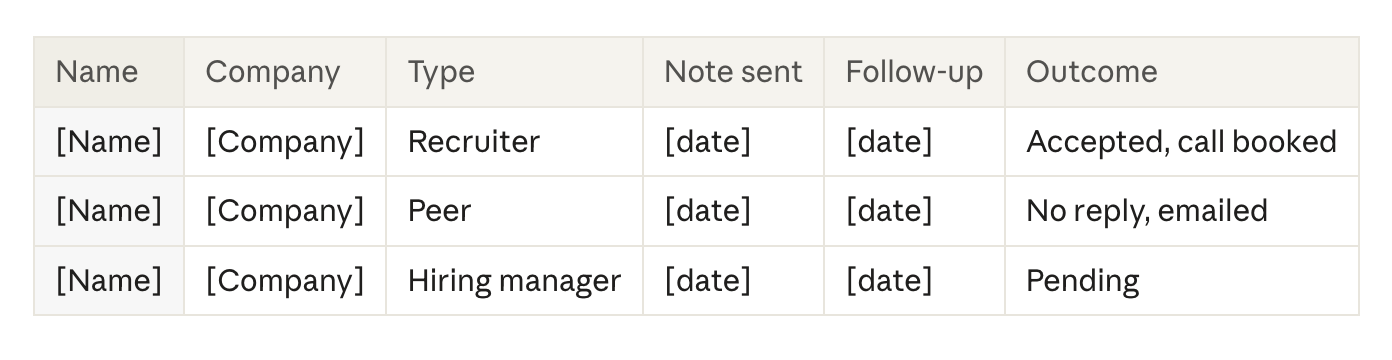
Track every person you message, so nothing slips. A simple table is enough:
Mistakes that get you ignored
Copy-paste notes. If the note could go to anyone, it reads like it did. Change at least the team and the result for every person.
Asking for a job in message one. Ask for advice or a short call instead. People say yes to small asks.
Writing an essay. If they have to scroll, they won't. Three short lines is plenty.
Messaging the whole team. Two or three people per company. More than that looks like spam.
Stopping after one message. A lot of replies come after the follow-up. Send it.
No link to your work. Your portfolio or website does the selling for you. Put it in every first note.
Key takeaways
Be intentional, not busy. Two or three of the right people at a company beat 50 random requests.
Know who you're talking to. Recruiters get you read, peers get you context and referrals, hiring managers make the call.
Fix your profile first. A clear headline, a photo, your portfolio link and one result with a number.
Connect with a note, never InMail. Short, specific, under 200 characters.
Ask for small things. Advice, a 15-minute call, a pointer to the right person. The referral follows.
No reply isn't the end. Find their email with Apollo and follow up on schedule.
Make it a system. Five people per dream company, tracked, repeated until the calls come.
I used to think networking meant asking people for things. It doesn't. Your value increases when you add value to others, and that starts with a message that respects their time.
Pick one company this week. Find five people. Send your first note today.
Want help doing this for your own search? I work 1:1 with jobseekers on their profile, target companies and outreach, in whichever country you're applying. Book some time - https://meetings.hubspot.com/jabez-ivan-joshiraj
📲 Connect with me on Instagram @jabezivanj and follow for job search tips that actually work.