I Reviewed All 18 Free Anthropic Courses So You Don't Have To 🎓
Last month, a student I mentor messaged me.
"Jabez, I applied to 200 jobs. Nothing. Every job ad says 'AI skills preferred.' I don't have money for a course. What do I do?"
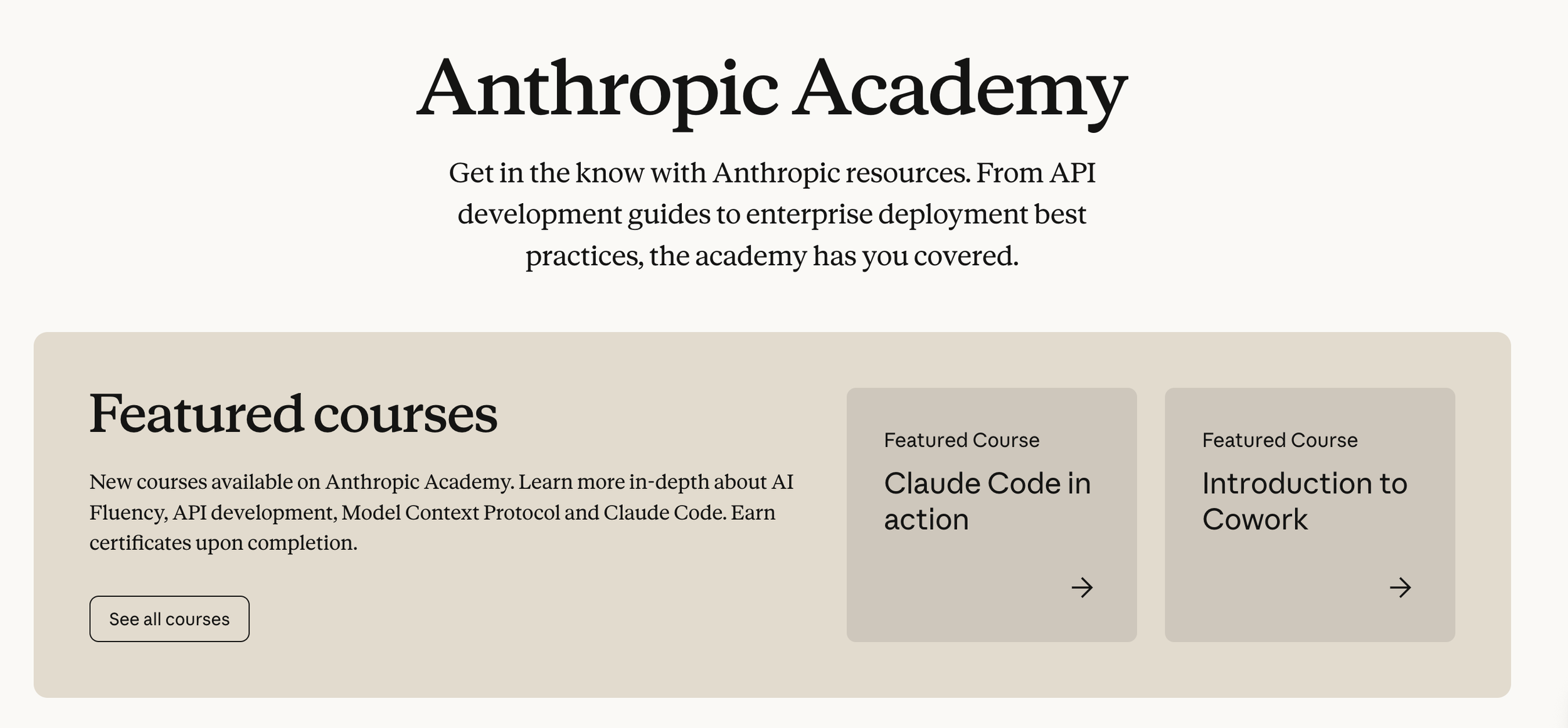
I sent her one link. The Anthropic courses page. Every single course on it is free. Most come with a certificate from the company that built Claude.
Her reply: "There are 18 courses?? Which one???"
And honestly? That's the real problem. Free AI education exists everywhere. What doesn't exist is someone telling you which ones matter for YOUR situation — landing a job.
So I went through all 18. This is that walk-through. Grab a coffee. ☕
How I'm rating these (so we're on the same page) 📏
Quick thing before we start. I'm not rating these like a tech reviewer. I'm rating them like a recruiter.
Every course gets a score out of 10, and the score answers exactly one question:
"If a job seeker spends an evening on this, does it make them more hireable?"
That's it. Not "is it well produced." Not "is it impressive." A course can be brilliant for engineers and still score a 3 here — because you're not trying to become an engineer. You're trying to get hired.
So when you see a low score, it doesn't mean bad course. It means wrong course for you. Keep that in mind the whole way through. 🎯
One note on timing: Anthropic doesn't publish official course lengths, so the times below are my rough estimates from the lesson counts. Some of you will move faster, some slower. Both are fine.
And one gut-check before we walk in: when a recruiter asks "how do you use AI?" — do you actually have an answer right now? Or would it be "umm, ChatGPT sometimes"?
Hold that question. We're coming back to it.
🥇 Start here: the course that changes how recruiters see you
AI Fluency: Framework & Foundations — 9.5/10
⏱️ Roughly 3–4 hours. One focused evening, or two relaxed ones.
First — what does "AI fluency" even mean? Think of it like being fluent in a language. Anyone can memorize a few phrases. But a fluent person can hold a real conversation, notice when something sounds wrong, and adjust. Same with AI. Anyone can type a question into ChatGPT. A fluent person knows what to ask, how to ask it, and — this is the big one — when the answer is wrong.
That's what this course teaches. And here's why it matters in an interview.
Two candidates, same marketing role, both used AI to prepare. Candidate A says: "I use AI to write my posts." Candidate B says: "I let AI write the first draft, then I check it for mistakes and add my own voice — because AI sometimes makes things up."
Who gets the job? B. Every single time. Because A sounds like someone who copies. B sounds like someone who thinks.
This course turns you into Candidate B. It was built with two real university professors, and it breaks the whole thing into four simple habits. In plain words:
1️⃣ What should I give to AI, and what should I keep for myself? (Your CV's first draft? Give it. The final decision on how you describe yourself? Keep it.)
2️⃣ How do I explain what I want so AI actually gets it? (Vague question in, vague answer out.)
3️⃣ How do I judge what comes back? (Is this true? Is this good? Would a recruiter buy this?)
4️⃣ How do I stay responsible for the result? (If AI writes something false on your CV — that's still on you.)
That's it. Four habits. And here's the deal — this is exactly the skill hiding behind every "AI literacy preferred" line you've seen in job ads. It works with any AI tool, not just Claude. Certificate at the end. Free.
The only people this course fails are the ones who watch it like Netflix and do nothing after. Don't be that person. ✋
🛠️ Your second stop: learn to actually drive the thing
Claude 101 — 9/10
⏱️ Roughly 2–3 hours. An evening.
If the first course teaches you how to think with AI, this one teaches you how to actually use Claude day to day. The buttons. The features. The stuff most people never touch.
Like — did you know you can give Claude a "project"? Basically a folder where you drop in your CV, your target job descriptions, your story. After that, you don't have to re-explain yourself in every chat. Claude already knows you. Imagine tailoring your CV for ten different jobs and never copy-pasting your background even once. 🤯
Or "research mode" — where instead of giving you one quick answer, Claude goes off and digs through many sources properly. Perfect for that "so what do you know about our company?" interview question that catches everyone off guard.
You know how I always say let Uncle Claude do the boring job-search work? Tailoring the CV. Researching the company. Prepping interview questions. This course is the instruction manual for Uncle Claude. 😄
Be honest — how many hours did your last application eat doing things a tool could've done in minutes?
This.
🎒 If you're a student, there's a detour built just for you
AI Fluency for Students — 8.5/10
⏱️ Roughly 1–1.5 hours. Shorter than a movie.
This one feels like it was made for my international students.
It covers two things. First, how to use AI to actually learn — not to cheat, but to understand things faster. Like having a study partner at 2am who never gets tired of your questions. Second — and this is your lane — how to use AI for career planning. Figuring out which roles fit you, what skills you're missing, how to get from where you are to where you want to be.
One catch: it builds on the four habits from the first course. So do that one first. This is dessert, not the main meal. 🍰
🤫 The sleeper pick nobody talks about
AI Capabilities and Limitations — 8/10
⏱️ Roughly 1–2 hours.
This course answers one simple question: how does AI actually work — and where does it break?
Why should a job seeker care? Picture the interview. The hiring manager asks, "What do you think about AI in this role?"
Most candidates ramble: "AI is amazing, it can do everything, it's the future." Sounds nice. Says nothing.
But you? You calmly say something like: "AI is great for first drafts and research, but it sometimes states wrong things with full confidence — so I always verify before anything goes out."
You just sounded smarter than 90% of the room. Not because you know more buzzwords. Because you understand the tool's weak spots. And knowing what AI can't do is exactly what separates an "AI user" from an "AI thinker."
Here's the deal — companies are hiring thinkers. 💡
🤝 Once you're comfortable: learn to manage, not just chat
Introduction to Claude Cowork — 7.5/10
⏱️ Roughly 2–3 hours, plus practice time on your own files.
Okay, what is "Cowork"? Simple version: normal Claude is a conversation — you ask, it answers. Cowork is Claude working on your computer, with your actual files. You don't ask it a question. You hand it a whole task.
Example: "Here's my folder with my CV and five job descriptions. Make me a tailored CV for each one." And then it... does it. Opens the files. Does the work. Produces real documents. Your job is to check the plan, watch the work, and correct it when it drifts.
Notice what just happened there. You're not chatting anymore. You're managing. Giving a task, reviewing the output, giving feedback. The exact thing a team lead does with a junior employee.
And "I can manage AI on real work" is quietly becoming a line that makes recruiters sit up. This course teaches exactly that skill. It's hands-on, so save it for after the basics. But if you're moving into office jobs, marketing, admin, or anything with reports and documents? This is your edge. 📈
🔀 The "depends who you are" zone
Now we hit the part of the catalog where the honest answer is: it depends on your career path. These aren't worse courses. They're narrower doors.
AI Fluency for Small Businesses — 6.5/10 · ⏱️ ~1–2 hours 🏪 Made for small business owners, not job seekers. But sneaky useful for two of you: the one freelancing while job hunting, and the one applying to a startup — because in a 10-person company, the unwritten part of every job description is "help us do more with less." Walk in knowing how AI does that, and you're suddenly very interesting.
Claude Code 101 — 6.5/10 · ⏱️ ~2–3 hours 💻 "Claude Code" is Claude for programmers — it writes and fixes computer code alongside you. So this one's only for the tech crowd: developers, CS students, career switchers heading into tech. For you, it's honestly an 8.5, because coding with AI is now expected in tech interviews. For everyone else? Skip it without guilt. You don't need it, and that's fine.
Introduction to Agent Skills — 6/10 · ⏱️ ~1–2 hours ⚙️ "Skills" here means teaching Claude your way of doing a repeat task — once — so it remembers forever. Like training a new assistant: "this is how I like my reports formatted," and from then on, it just does it that way. Saying "I built my own AI workflows" sounds brilliant in an interview. But fair warning: this lives inside the programmer tools, so there's a learning curve. One for the ambitious, later.
🔧 The builder's wing: beautiful, but probably not your door
Walk a little further and the catalog changes completely. Six courses, all about building AI products:
· Claude Platform 101 (5.5)
· Building with the Claude API (5.5)
· Intro to MCP (5)
· MCP: Advanced Topics (4)
· Intro to Subagents (4)
· Claude Code in Action (5)
⏱️ Each roughly 2–5 hours.
Quick translation, because these names mean nothing to a normal human: an "API" is the behind-the-scenes plumbing developers use to put Claude inside their own apps. "MCP" is a way to connect AI to other software — your email, your calendar, a company's database. "Subagents" are small AI helpers working under a main one, like a team under a manager.
Interesting? Sure. Needed for your job search? No.
Here's the thing — these are genuinely good courses. That's not the issue. They're for people whose dream job is building AI products. If that's you, go — they're valuable, and the skills are hot in tech hiring right now.
But if you're chasing a finance, HR, or marketing role? Starting here is like learning to build a car engine when all you needed was a driving license. You'll feel lost, decide "AI isn't for me," and quit.
Don't let the wrong course steal your confidence. 🚗
❌ And the rooms that simply aren't yours
· AI Fluency for Educators (3)
· Teaching AI Fluency (3)
· AI Fluency for Nonprofits (3)
· Claude with Amazon Bedrock & Google Vertex AI (2.5 each)
These are for teachers, course designers, charity teams, and cloud engineers (the Bedrock and Vertex ones teach companies how to run Claude on Amazon's and Google's servers — yes, that specific). Good courses. Wrong door.
One exception: if you're specifically job-hunting in education or the nonprofit world, take the matching course and it jumps to a 6 — because it teaches you to speak that sector's language before the interview. 🎯
💬 The honest truth about this whole catalog
Here's what nobody will tell you: this page is heavily built for developers. Roughly 10 of the 18 courses are technical. Land there cold, and it feels like walking into a library where most books are in a language you don't speak.
But flip it. You don't need 18 courses. You need 4. Maybe 5.
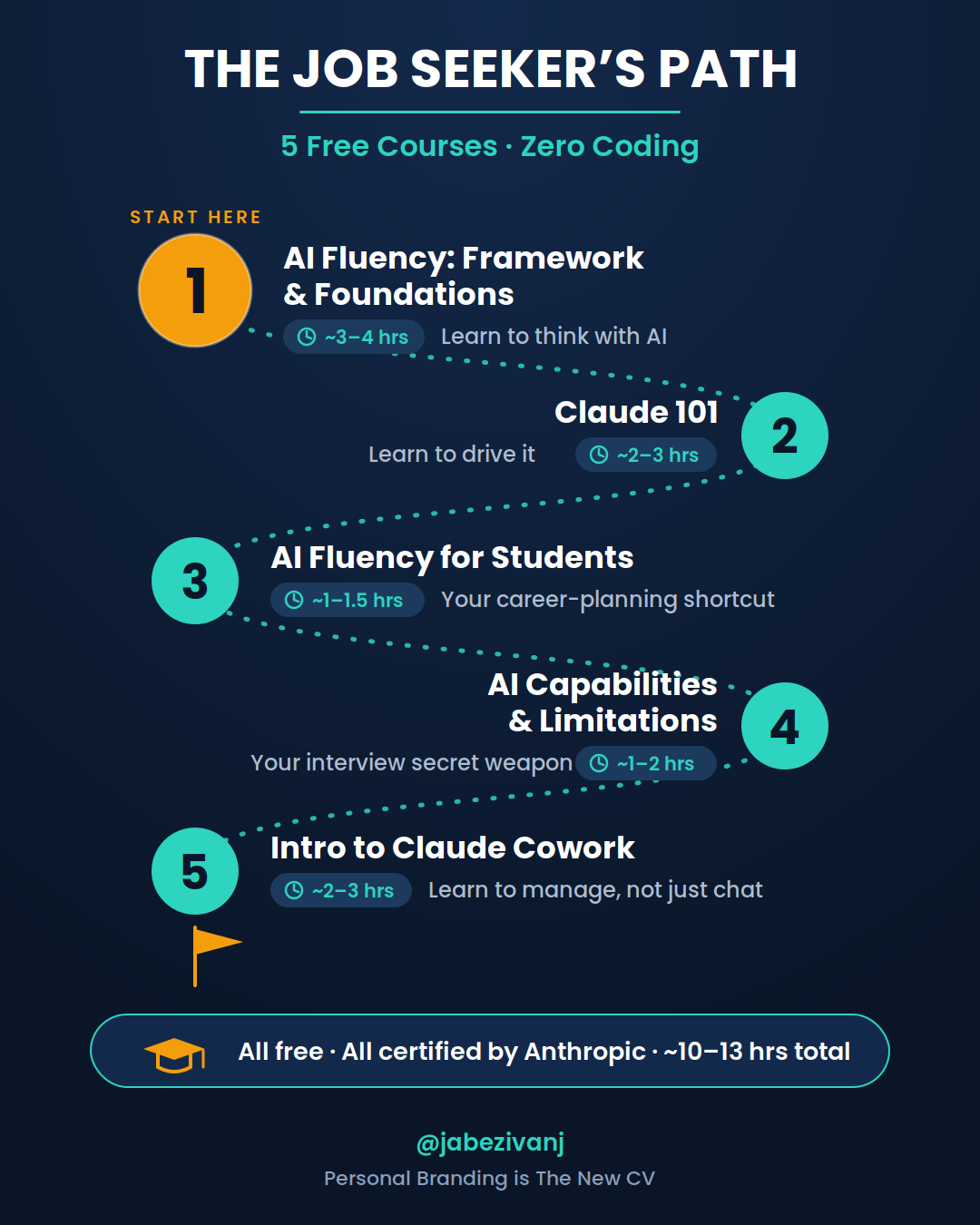
Your path:
1️⃣ AI Fluency: Framework & Foundations (~3–4 hrs) — learn to think with AI
2️⃣ Claude 101 (~2–3 hrs) — learn to drive it
3️⃣ AI Fluency for Students — if you're studying (~1–1.5 hrs) — your career-planning shortcut
4️⃣ AI Capabilities and Limitations (~1–2 hrs) — your interview secret weapon
5️⃣ Cowork, when you're ready (~2–3 hrs) — learn to manage, not just chat
Add it up. That's roughly 10–13 hours total. Less time than you spent scrolling job boards last week. All free. All with certificates. Zero coding. 🛤️
Remember that question from the start — "how do you use AI?"
After this path, you'll have a real answer. With Anthropic certificates sitting on your LinkedIn to back it up. While other candidates paid hundreds for courses that taught them less. 📜
So be honest with yourself: what's actually stopping you now? It's not money. It's not access.
It's one evening and a decision.
Your future self is already sitting in that interview. Make sure they have something to say. 🙌
If this helped:
Follow me @jabezivanj — I share job search strategies that actually work, from someone who sat helping 3000+ jobseekers land their dream job.
Peace. ✌️